Data Center — a private analytics platform for 10+ MW data center buildings
Turnkey data centers, powered shells, AI and mining campuses and industrial sites with substations across the USA, Canada and Europe in one private catalog, with a 0–100 score and a five-year cost of ownership for every site.
energized capacity, up to 69,111 MW with expansion
26,182 MW
regional tariff and tax incentive benchmarks
74
// How it works
data-center.ink
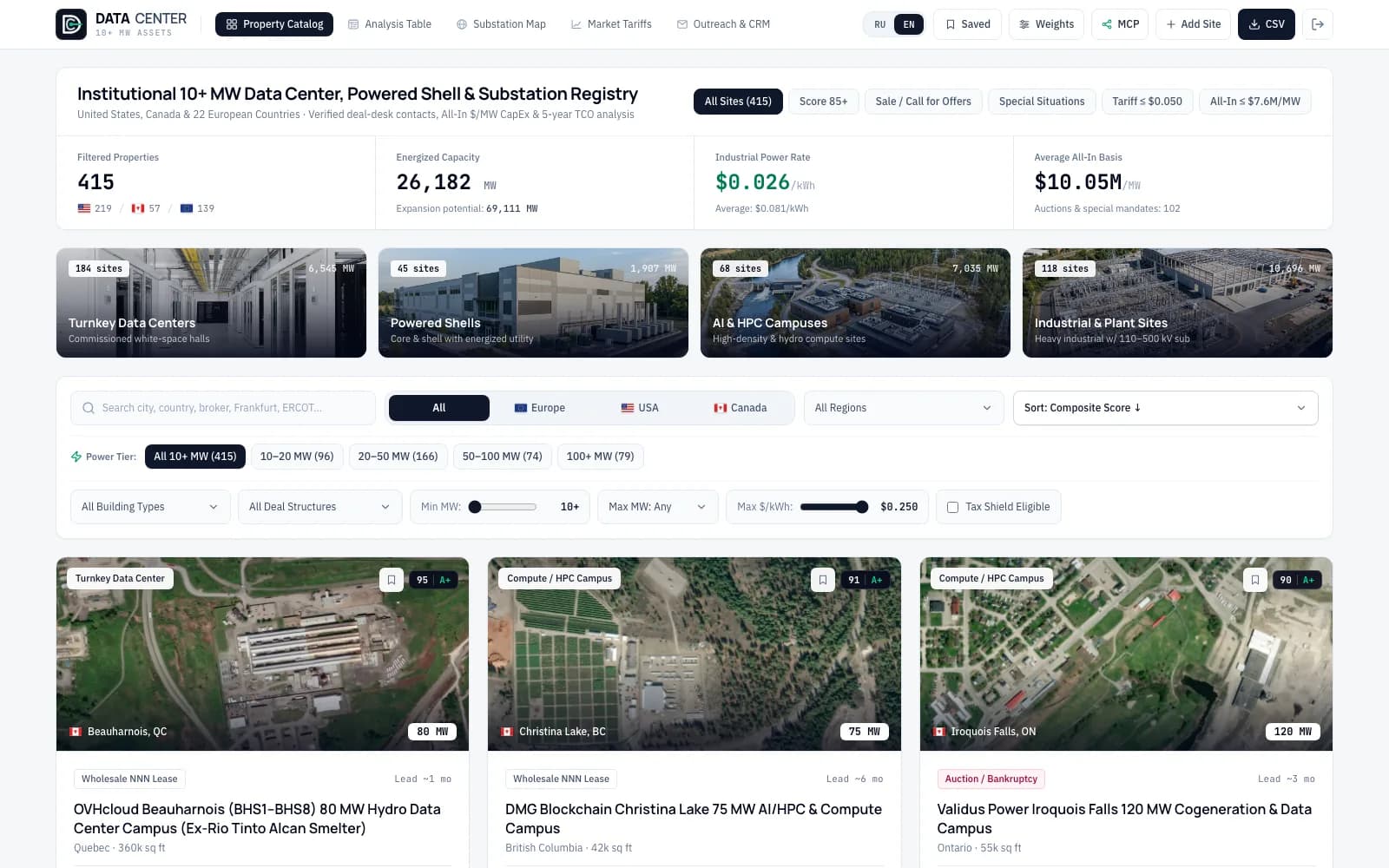
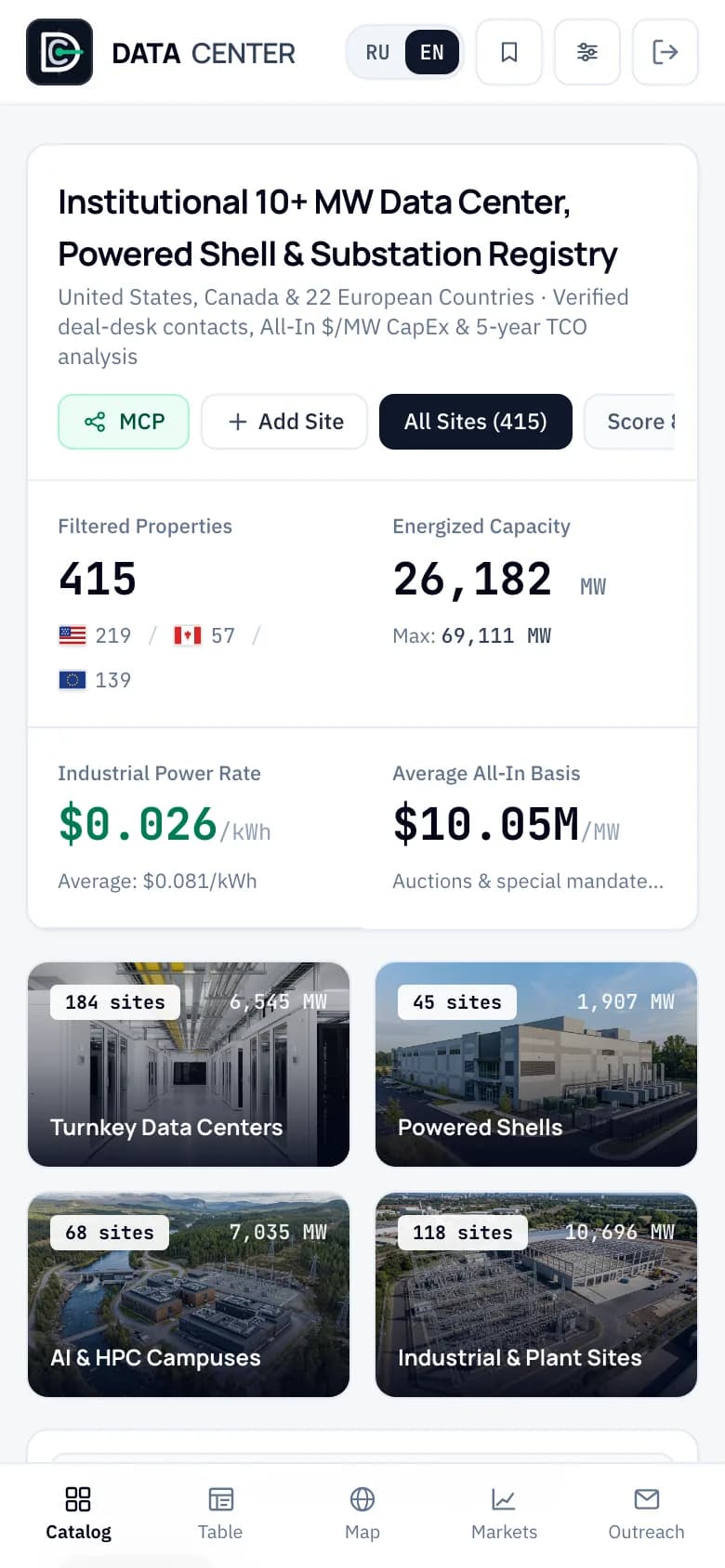
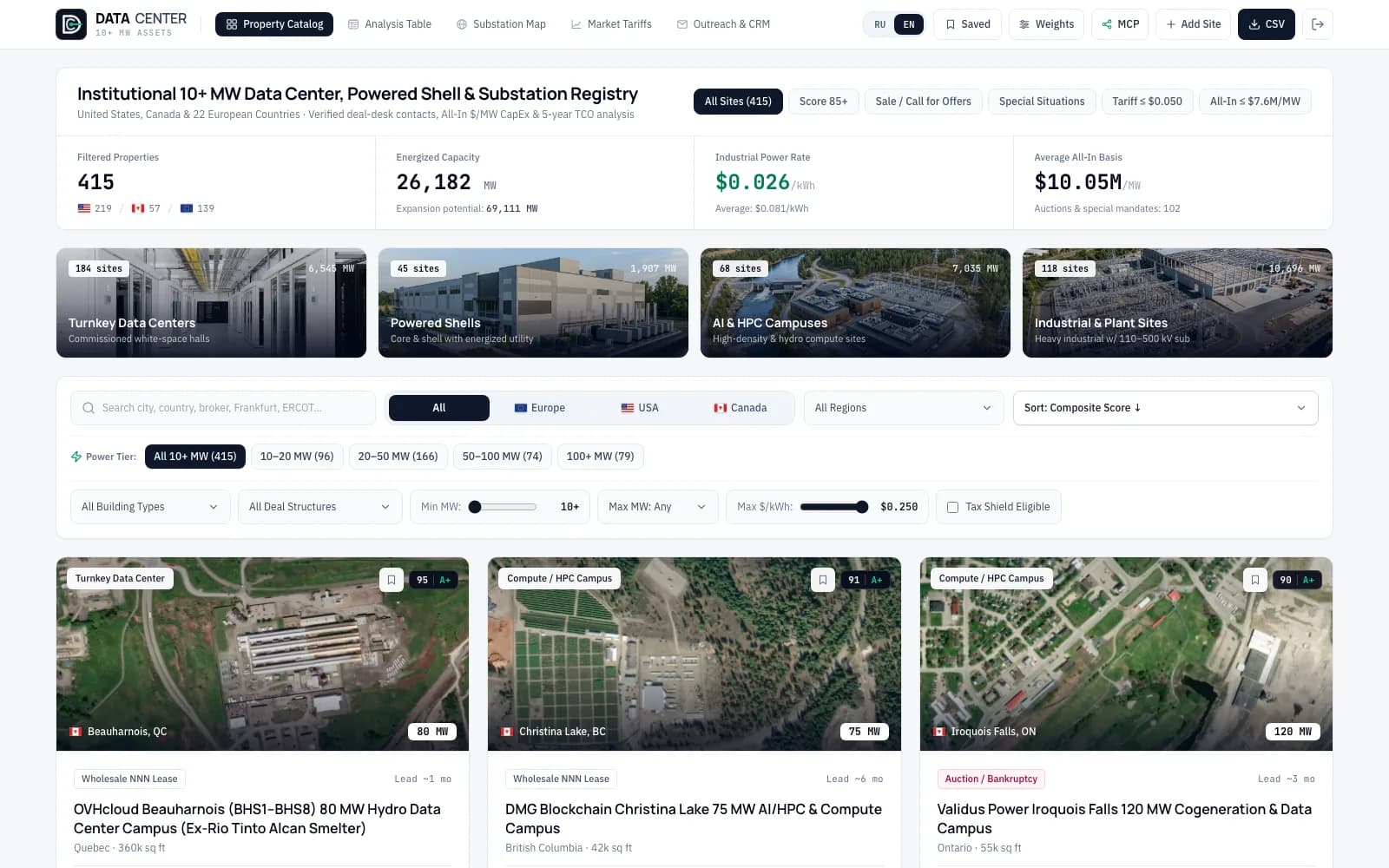
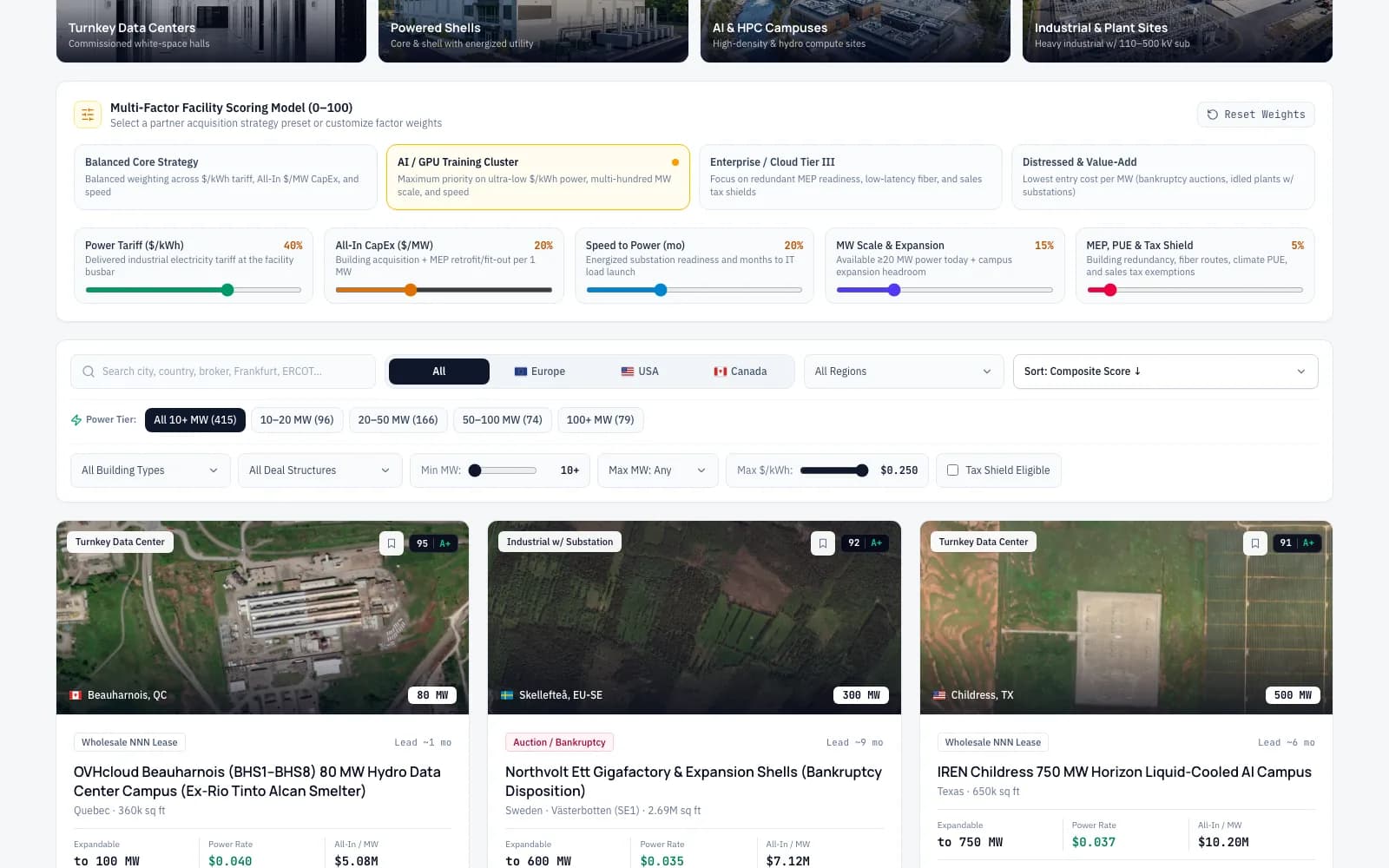
Catalog: 415 sites, 26,182 MW and four building classes
data-center.ink
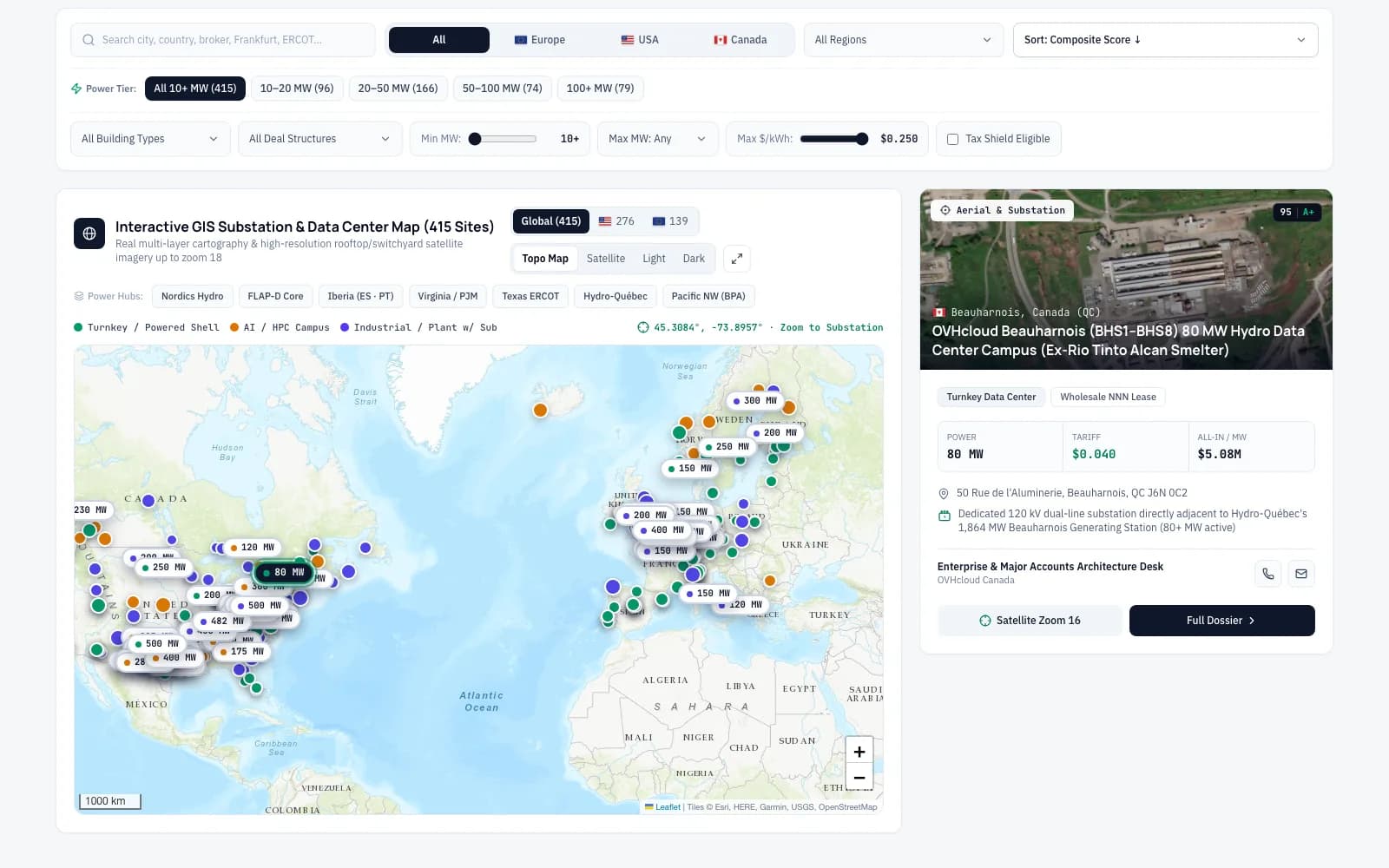
GIS map of sites across North America and Europe
data-center.ink
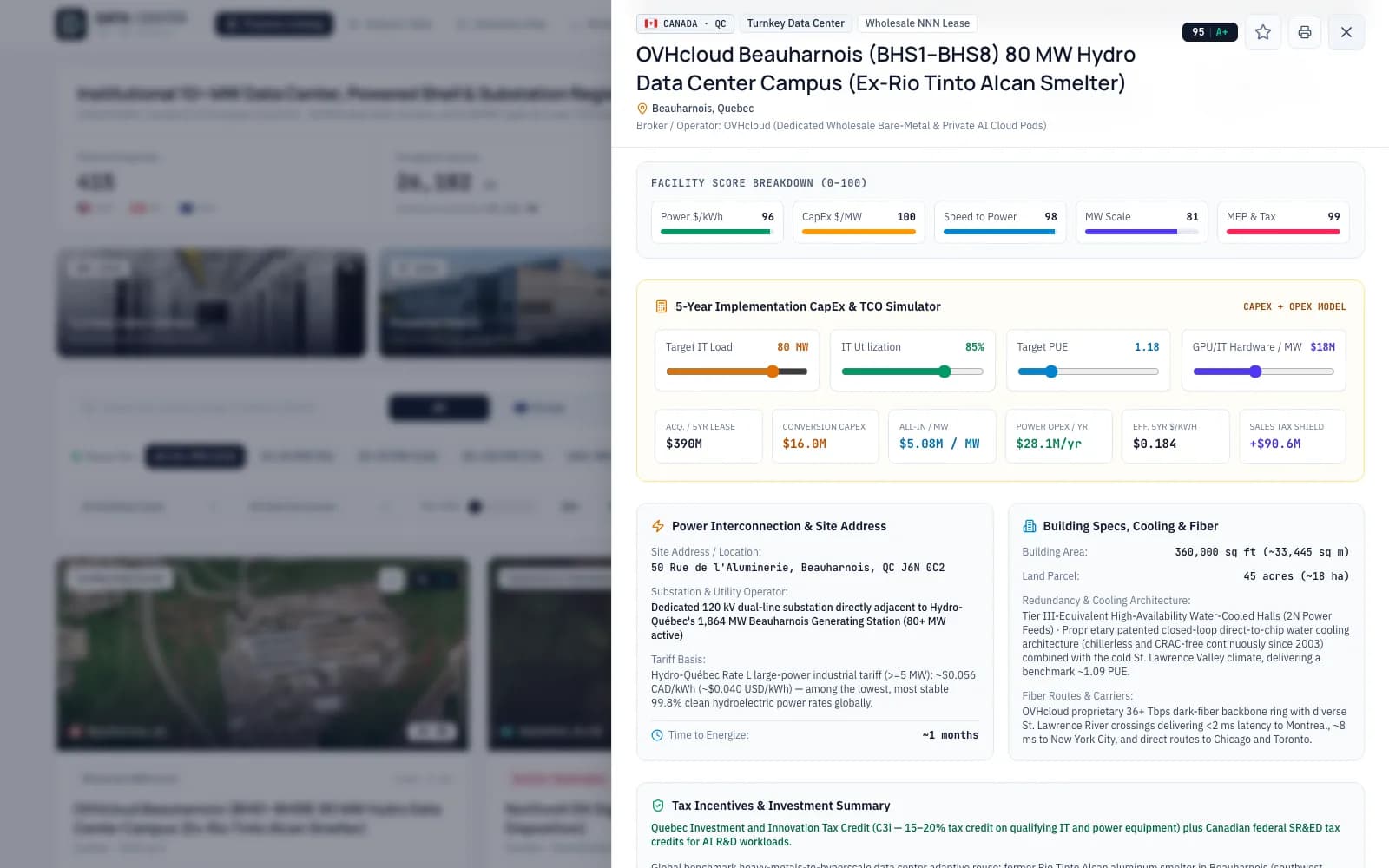
Site dossier: score breakdown and 5-year TCO calculator
data-center.ink
Scoring model: AI cluster preset and five factor weights
data-center.ink
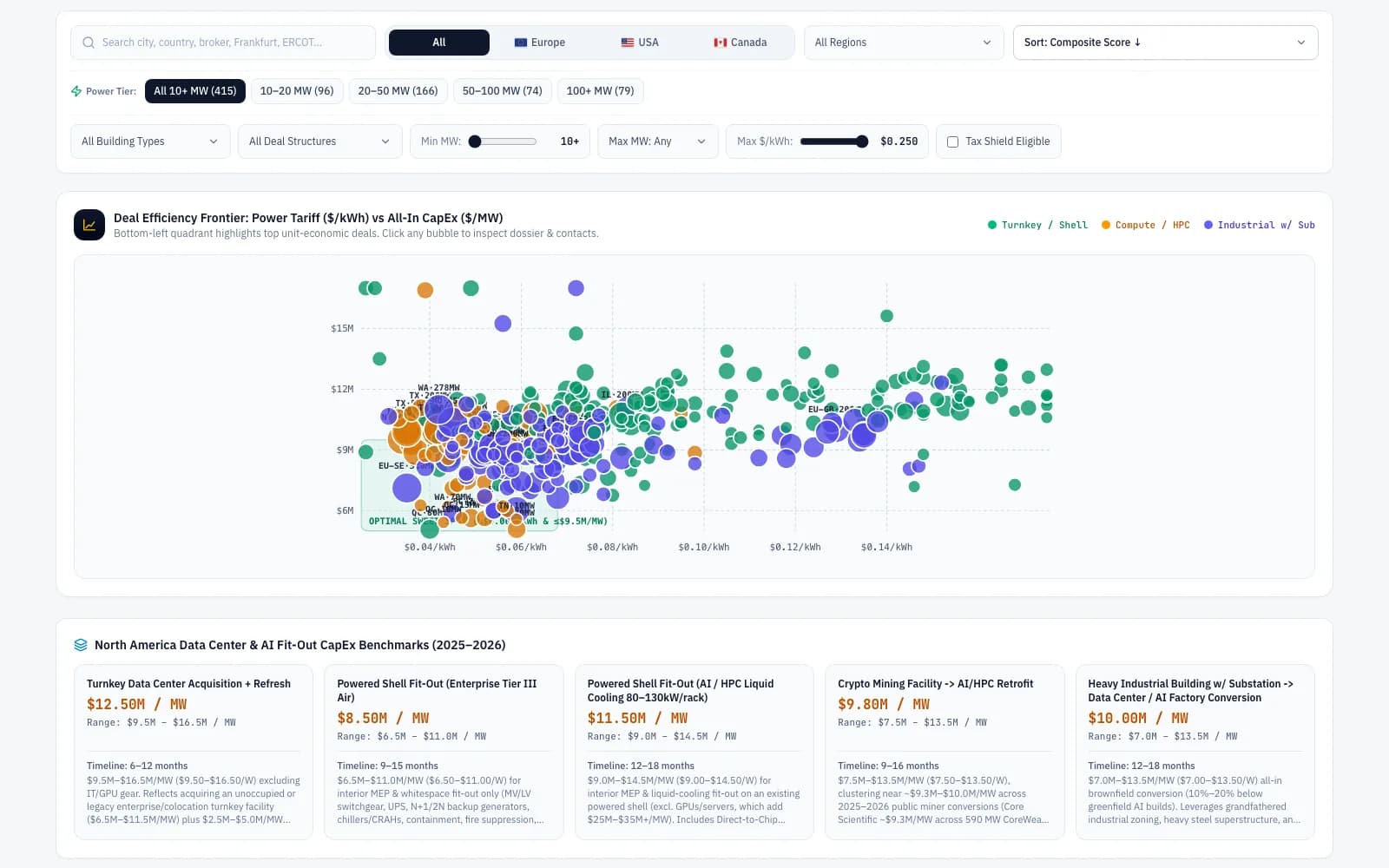
Tariff and all-in $/MW matrix with CapEx benchmarks
What we built
Next Robot built Data Center on Next.js as a private bilingual platform with an RU | EN switch. The registry holds 415 sites in 42 US states, 8 Canadian provinces and 22 European countries, each with coordinates, a satellite image, the substation, tariff and deal terms. The scoring engine computes a 0–100 score from five factors: tariff per kWh, all-in cost per MW, time to power, scale, and MEP readiness with tax incentives; four strategy presets shift the weights, and sliders tune them by hand. In the site dossier a calculator models IT load, utilization, PUE and hardware and returns the cost per MW, the annual power bill and the effective five-year cost per kWh. A Leaflet GIS map shows sites across North America and Europe on four basemaps, and the markets section brings together 74 regional tariff benchmarks and CapEx norms. The CRM tracks investors and the deal pipeline, and an MCP server opens the database to the team's AI agents.
Registry of 415 sites from 10 MW: turnkey data centers, powered shells, AI and mining campuses, industrial sites and power plants with high-voltage substations
Coverage: 42 US states, 8 Canadian provinces and 22 European countries; 26,182 MW energized and up to 69,111 MW with expansion
0–100 score on five factors with grades from A+ to C; four presets: balanced, AI training cluster, Tier III cloud, distressed and special situations
Dossier calculator: target IT load, utilization, PUE and hardware per MW give the all-in cost per MW, the annual power bill, the five-year $/kWh and the sales tax shield
// Stack
Next.js
Leaflet
Scoring engine
5-year TCO model
Outreach CRM
MCP server
2 languages
// How it works
Step by step
#01
Site registry
The database collects turnkey data centers, powered shells, AI and mining campuses and industrial sites with substations from 10 MW. Every site carries coordinates, a satellite image, the substation and grid operator, tariff, floor area, deal terms and the original source, with every field in Russian and English.
#02
Five-factor score
The engine rates the tariff per kWh, all-in cost per MW (purchase or a five-year lease plus fit-out), time to power, scale with expansion headroom, and MEP readiness with tax incentives. The result is a 0–100 score and a grade from A+ to C; four strategy presets and manual sliders shift the weights, and the ranking updates at once.
#03
Screening on the map and in the catalog
An analyst filters sites by country, region, building type, deal format, capacity and tariff, browses cards or the analysis table and checks sites on the GIS map of North America and Europe. The tariff and cost-per-MW matrix highlights the zone with the best unit economics.
#04
Dossier and five-year TCO
In the site dossier the calculator takes target IT load, utilization, PUE and hardware cost per MW and computes the all-in cost, the annual power bill, the effective five-year cost per kWh and the tax savings. Up to four sites line up in one comparison table, and the dossier prints in one click.
#05
Deals and AI agents
Selected sites move into the CRM: investors, a deal pipeline with stages from NDA request to LOI, client digests and broker requests. The MCP server with 12 tools gives Claude, Cursor and ChatGPT access to search, dossiers, TCO and benchmarks with a personal token.
// FAQ
Questions and answers
What is Data Center?
Data Center is a private analytics platform built by Next Robot for data center buildings of 10 MW and up in the USA, Canada and Europe: turnkey data centers, powered shells, AI and mining campuses, industrial sites and power plants with substations. As of November 2026 the registry holds 415 sites: 219 in the USA, 57 in Canada and 139 in 22 European countries, with 26,182 MW of energized capacity. The platform runs in Russian and English, with password sign-in at data-center.ink.
How does Data Center rate a site?
The scoring engine gives five sub-scores: power tariff, all-in cost per MW, time to power, scale with expansion headroom, and MEP readiness with tax incentives and PUE. Their weighted sum is a 0–100 score with a grade from A+ to C. The balanced preset weighs the tariff at 30%, cost at 25%, speed at 20%, scale at 15% and MEP at 10%; the AI training cluster preset raises the tariff weight to 40%. The dossier calculator adds fit-out and annual power use at the chosen IT load, utilization and PUE to the entry price and returns the all-in cost per MW, the annual power bill and the effective five-year cost per kWh.
Which technologies and integrations does Data Center use?
Next Robot built Data Center on Next.js 15 and React 19 with TypeScript and Tailwind CSS. The GIS map runs on Leaflet with Esri basemaps: topographic, satellite, light and dark. Scoring and TCO run in TypeScript on the server and in the browser, and the interface and data are localized into Russian and English. The CRM sends campaigns through SMTP or Resend. The MCP server supports protocol versions 2025-03-26 and 2024-11-05 and connects to Claude Code, Claude Desktop, Cursor, Windsurf and ChatGPT with HMAC-signed tokens.
How can I get a similar system from Next Robot?
Next Robot builds analytics platforms on the Data Center model: asset registries, multi-factor scoring, financial calculators, GIS maps, CRM and MCP access for AI agents. Start with a free AI audit call. An engineer sends an estimate within 24 hours, and the next step is a fixed-price pilot with agreed KPIs. Next Robot signs an NDA on request.
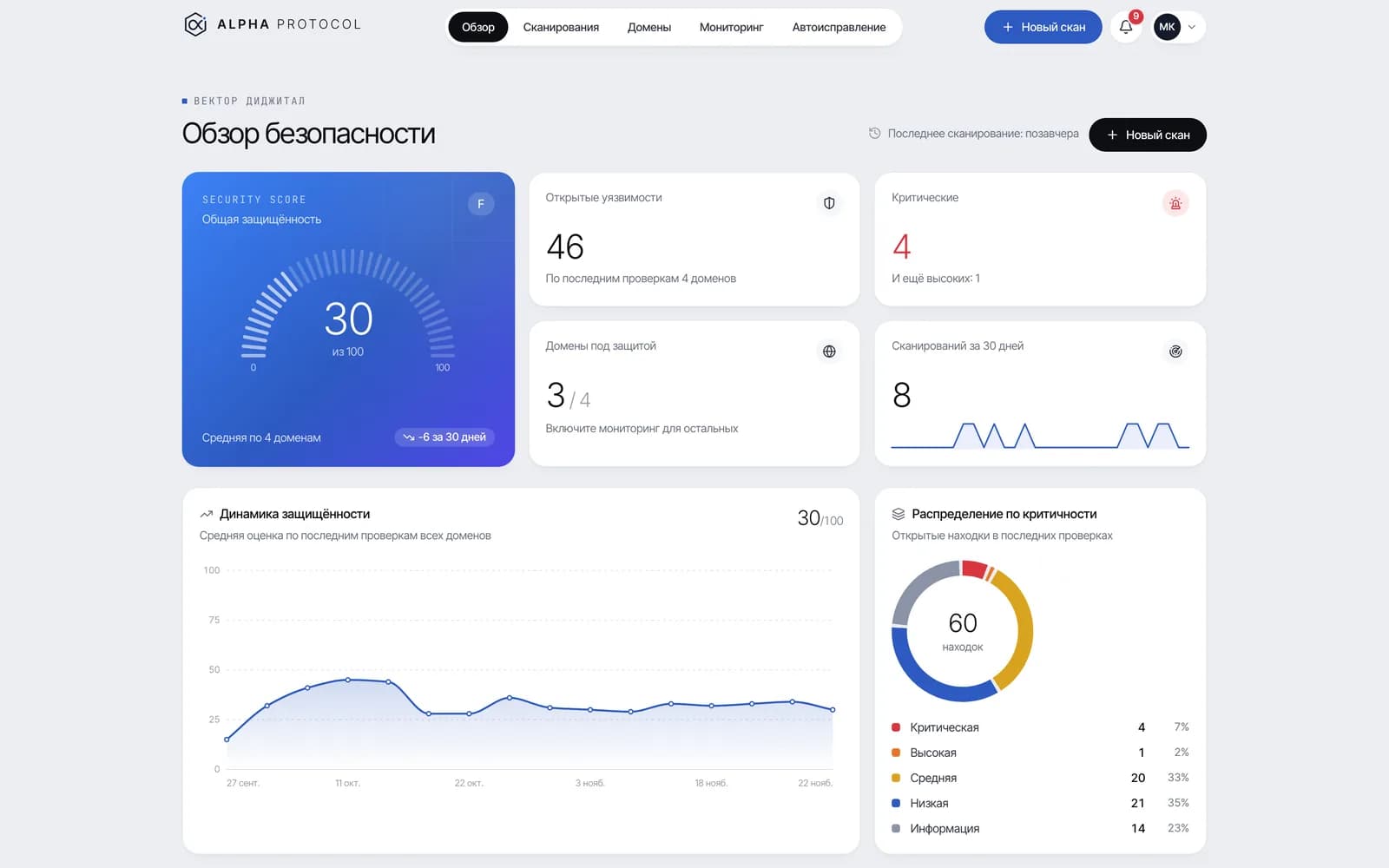
A website security audit service: a site address becomes a report with a 0–100 score, an AI risk review, a PDF for management and a fix request in the CRM.
// Your project
Let's build this for you
Describe the task. An engineer replies within 24 hours with a plan and an estimate.