Istmo Auction — a private terminal for Costa Rica and Panama auctions and bank-owned property
Court auctions, bank-repossessed property, classifieds and MLS listings of two countries in one private catalog, with a renovation or construction financial model for every lot.
platforms in one catalog: courts, banks, classifieds and MLS in two countries
12
factors in the 0–100 score of every lot
5
micro-districts in the market price-per-m² benchmark
17
// How it works
auction.co.im
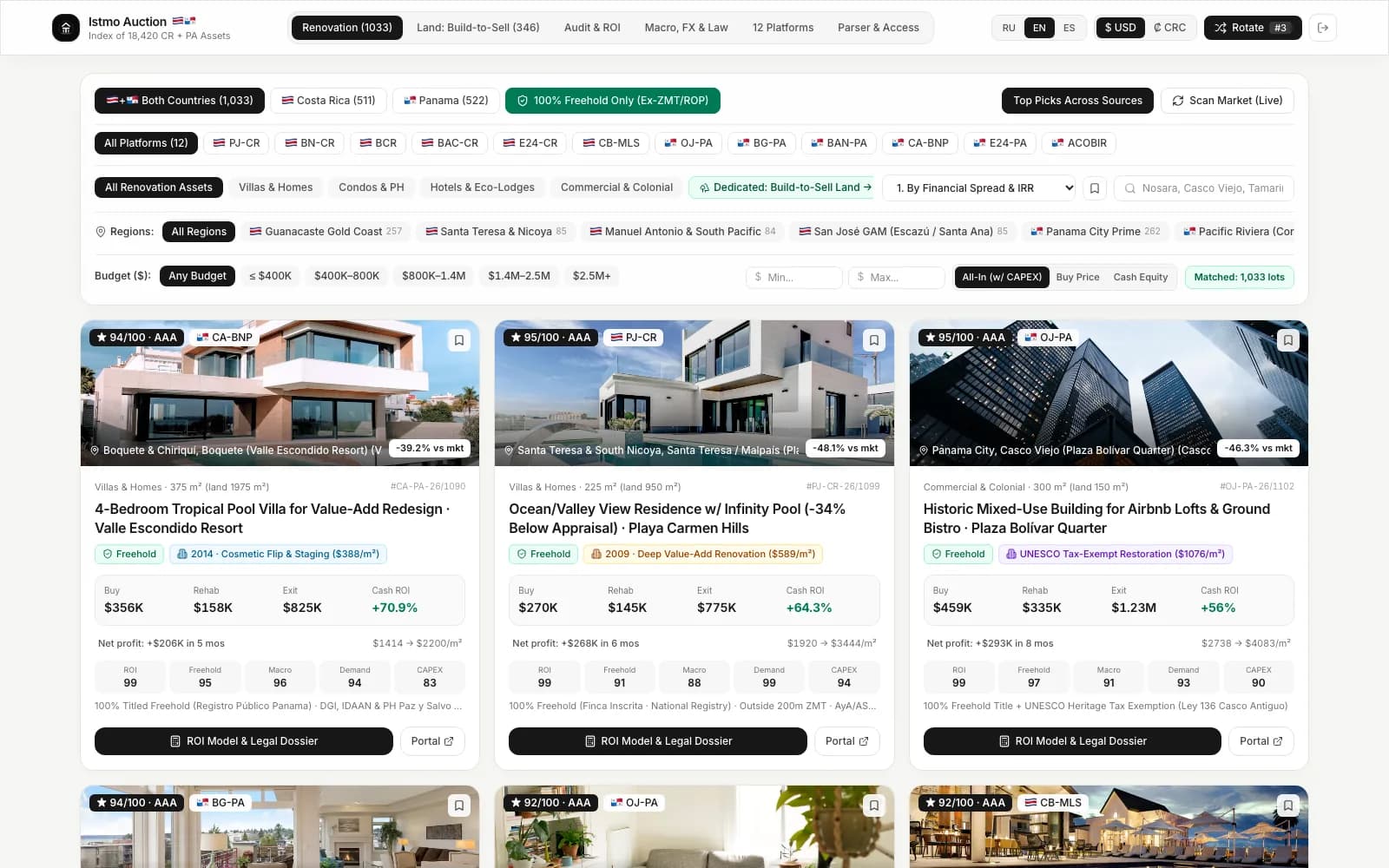
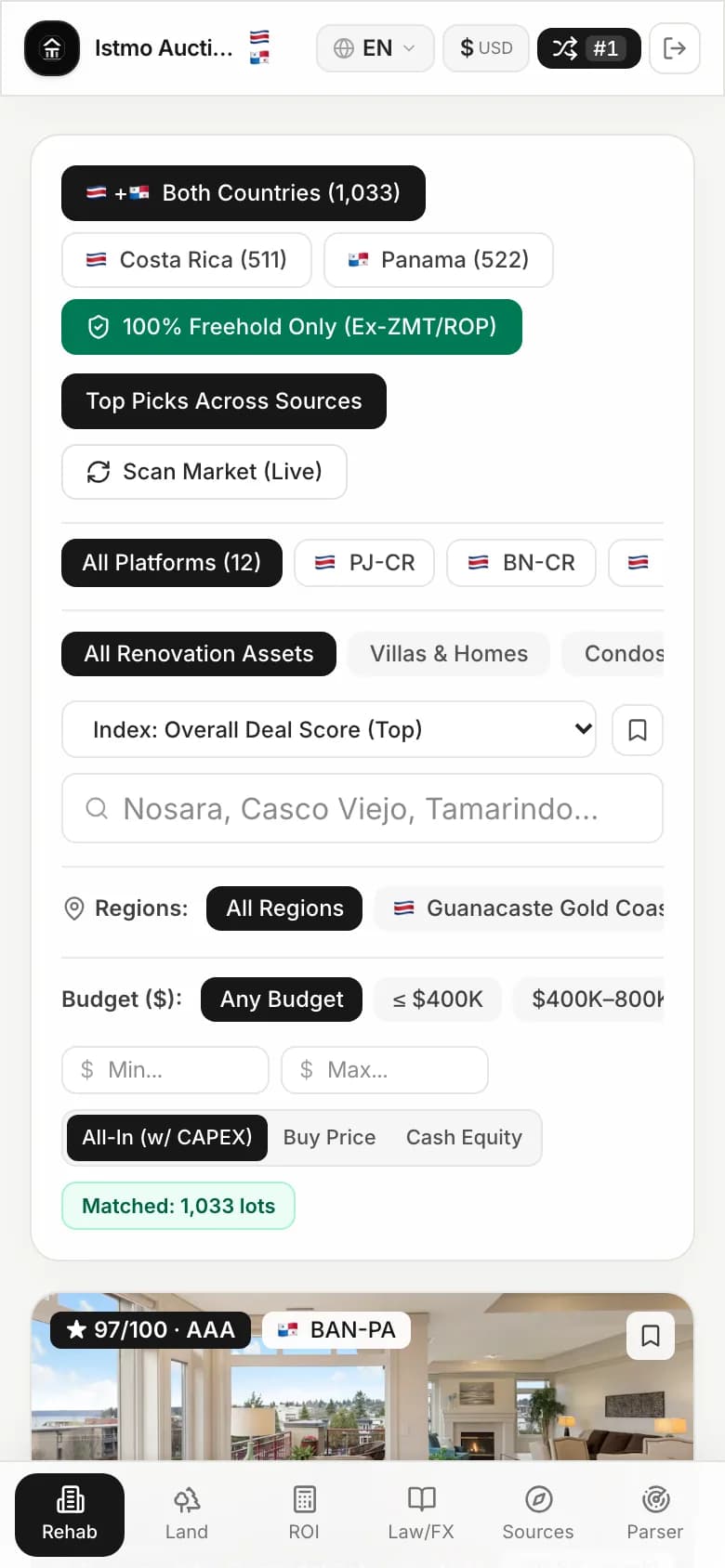
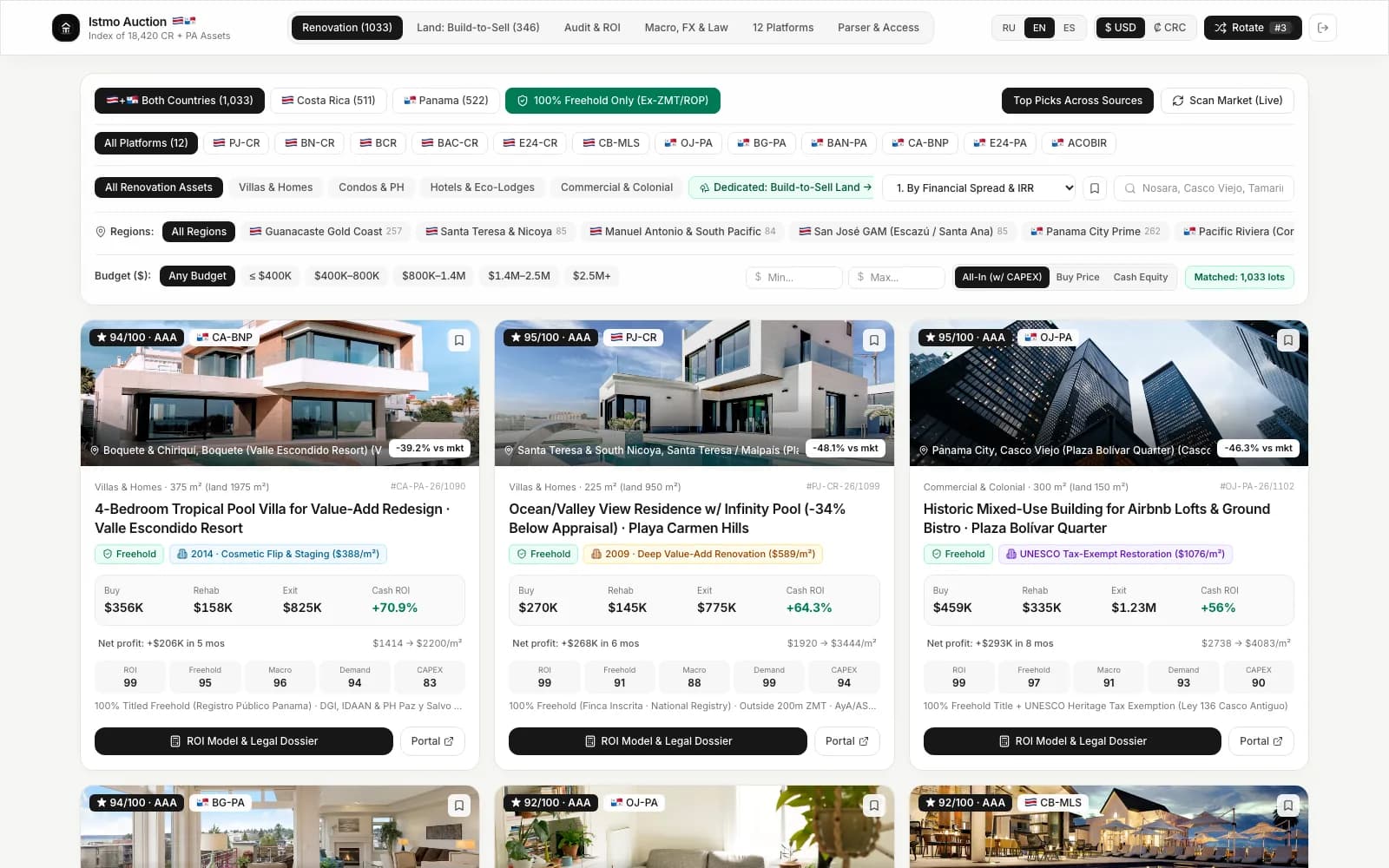
Lot screener: 0–100 score and five factors across 12 Costa Rica and Panama platforms
auction.co.im
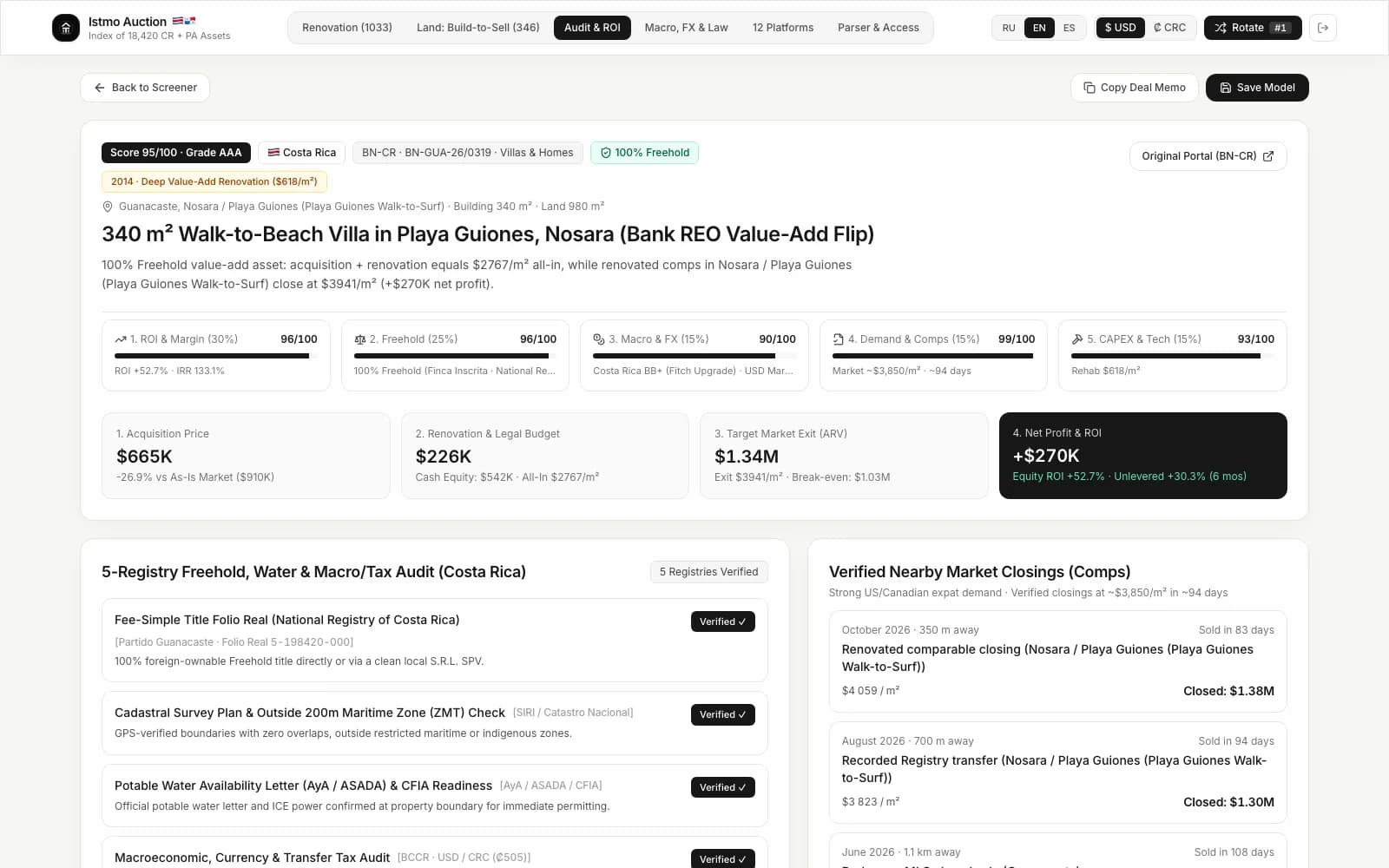
Nosara villa lot card: score 95/100, financial model and legal audit
auction.co.im
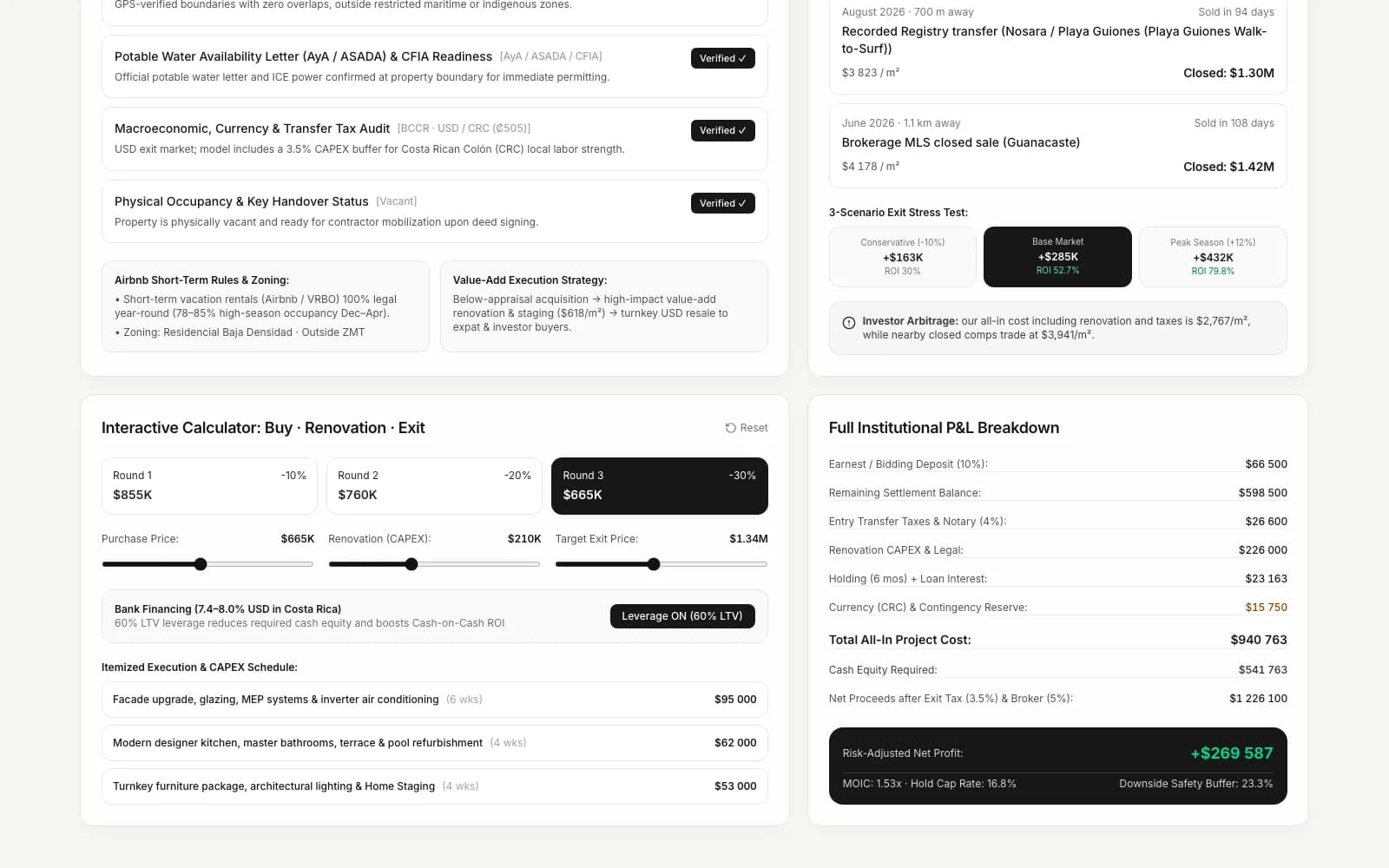
Calculator by auction round, exit stress test and full deal P&L
auction.co.im
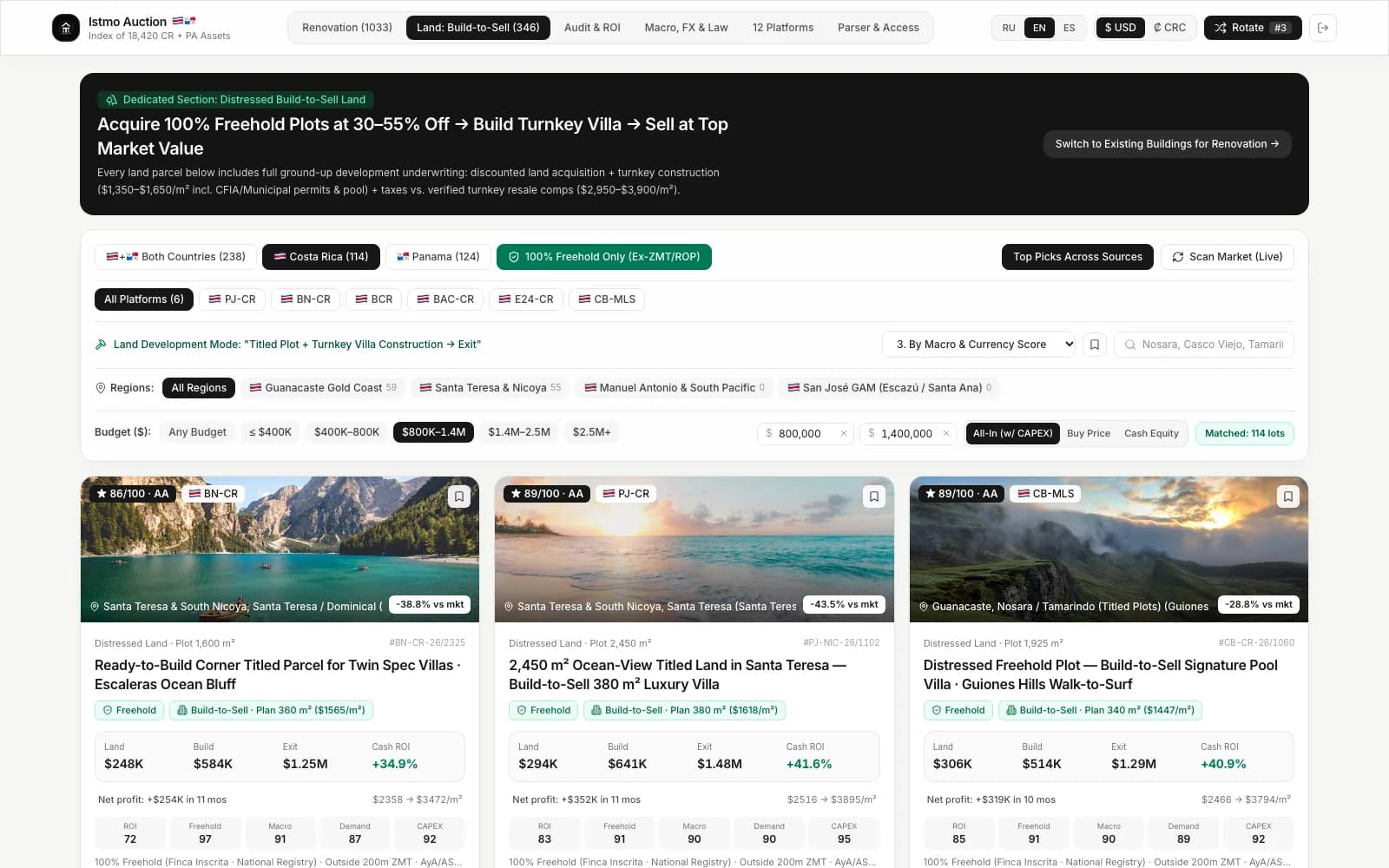
Land: Build-to-Sell — plot, villa construction and sale in one model
auction.co.im
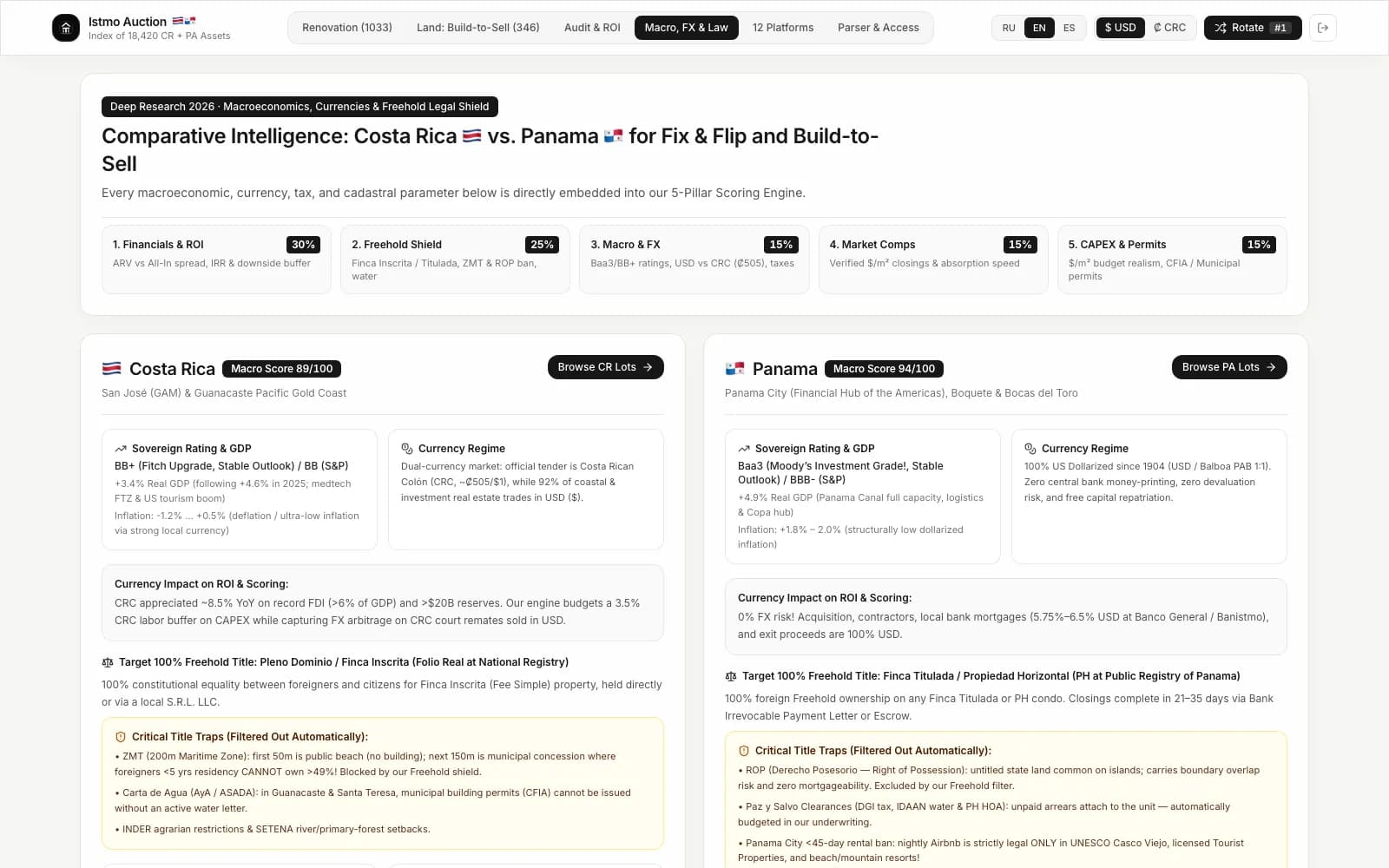
Macro, FX and law: Costa Rica and Panama side by side with the five factor weights
What we built
Next Robot built Istmo Auction on the architecture and design of Thai Auction: a private Next.js terminal in Russian, English and Spanish. The catalog is built around 12 platforms, six in each country: the Poder Judicial and Órgano Judicial court auctions, the repossessed-property portals of Banco Nacional, BCR, BAC, Banco General, Banistmo and Caja de Ahorros, Encuentra24 classifieds and broker MLS catalogs. For every lot the engine builds a financial model: buyout price by auction round, deposit, entry taxes, renovation or construction budget, holding costs, leverage, exit taxes and broker fees. Next to the exit price per m², the lot card shows the district market price per m² from a benchmark of 17 micro-districts. Scoring combines ROI, Freehold title quality, macro and currency, demand and budget realism into a 0–100 score graded from AAA to B. A dedicated Land: Build-to-Sell section models buying a plot, building a turnkey villa and selling it.
Catalog of 12 platforms: court auctions in both countries, repossessed property from seven banks, Encuentra24 classifieds and broker MLS catalogs
Two sections: renovation assets — villas, condos and penthouses, hotels, colonial buildings and commercial property — and Land: Build-to-Sell
0–100 score on five weighted factors: ROI 30%, Freehold title 25%, macro and currency 15%, demand 15%, budget 15%
Freehold filter: lots in the ZMT maritime zone and lots held under ROP possession rights are capped at 58 points with a C-RISK grade
// Stack
Next.js
React 19
Financial model
Rule-based scoring
Scrapers
3 languages
// How it works
Step by step
#01
Twelve platforms
The catalog is built around 12 platforms, six in each country: the Poder Judicial and Órgano Judicial court auctions, the repossessed-property portals of Banco Nacional, BCR, BAC Credomatic, Banco General, Banistmo and Caja de Ahorros, Encuentra24 classifieds and the Coldwell Banker and ACOBIR MLS catalogs. For each platform the terminal shows the bidding mechanics, the typical discount and the deposit rule. An analyst adds a single lot from a link.
#02
Renovation financial model
The engine takes the appraisal and the auction round, then calculates the buyout price, deposit, entry taxes, renovation and legal budget, holding costs and loan interest. Next to the exit price per m², the card shows the market price per m² of the micro-district. The output is the full budget, the equity needed, net profit, IRR, MOIC and the break-even price, plus a conservative (−10%) and a peak-season (+12%) exit scenario.
#03
Land: Build-to-Sell
A dedicated section models plots for development: the land price, a turnkey villa at a cost per m², permits and taxes, and the sale of the finished home at the district price. The land catalog filters by country, platform, region and budget in the same way as renovation assets.
#04
Five-factor score
Every lot gets a 0–100 score: ROI and margin weigh 30%, Freehold title 25%, macro and currency, demand and budget realism 15% each. The score maps to a grade from AAA to B. Lots in the ZMT maritime zone and lots held under ROP possession rights are capped at 58 points with a C-RISK grade.
#05
Audit and deal memo
In the lot card the investor sees a five-point legal audit, the district price per m² and a three-scenario stress test. Sliders for buyout price, renovation and exit price recalculate the full deal P&L with the currency reserve, the model is saved, and the investment memo copies in one click.
// FAQ
Questions and answers
What is Istmo Auction?
Istmo Auction is a private investment terminal built by Next Robot for buying and renovating distressed real estate and land in Costa Rica and Panama: assets from court auctions, homes and condos repossessed by banks, motivated-seller classifieds and MLS listings. The terminal brings 12 platforms into one catalog and builds a financial model and a 0–100 score for every lot. The platform runs on the Thai Auction architecture. The public page auction.co.im runs in Russian, English and Spanish, and the catalog and models open to members with personal access and owner, analyst or investor roles.
How does Istmo Auction calculate the economics of a lot?
Istmo Auction starts from the appraisal and the discount of the chosen auction round. The terminal describes the bidding rules of each country: Costa Rica court auctions step from 100% of the base to 75% and 25%, and in Panama round one opens at 2/3 of the appraisal and round two at 50%. The model splits the buyout price into the deposit and the balance, then adds entry taxes and notary fees (about 4% in Costa Rica, 1.2–1.8% in Panama), the renovation or construction budget, legal and permit costs, holding costs and interest when the deal uses a bank loan. On resale it applies the seller's tax and a broker commission, typically 5%. For Costa Rica the model adds a currency reserve of 3.5% of the works budget for local crews paid in colones. The result is net profit, return on equity, IRR, MOIC, the break-even price and the safety margin; the engine also runs conservative and peak-season exit scenarios.
Which technologies and sources does Istmo Auction use?
Next Robot built Istmo Auction on Next.js and React 19 with TypeScript and Tailwind CSS. The catalog covers 12 platforms: Poder Judicial, Banco Nacional, Banco de Costa Rica, BAC Credomatic, Encuentra24 and Coldwell Banker in Costa Rica; Órgano Judicial, Banco General, Banistmo, Caja de Ahorros with Banco Nacional de Panamá, Encuentra24 with CompreoAlquile, and Panama Realtor with ACOBIR in Panama. The parsing module imports a lot from a link and reads the page with cheerio. The financial engine and the five-factor scoring are written in TypeScript, and the legal audit follows local practice: Finca Inscrita and Finca Titulada titles, the ZMT maritime zone, AyA/ASADA water letters and Paz y Salvo clearances. Prices show in dollars and colones.
How can I get a similar system from Next Robot?
Next Robot builds investment terminals on the Istmo Auction model: platform parsing, deal financial models, asset scoring and private cabinets with roles. Start with a free AI audit call. An engineer sends an estimate within 24 hours, and the next step is a fixed-price pilot with agreed KPIs. Next Robot signs an NDA on request.
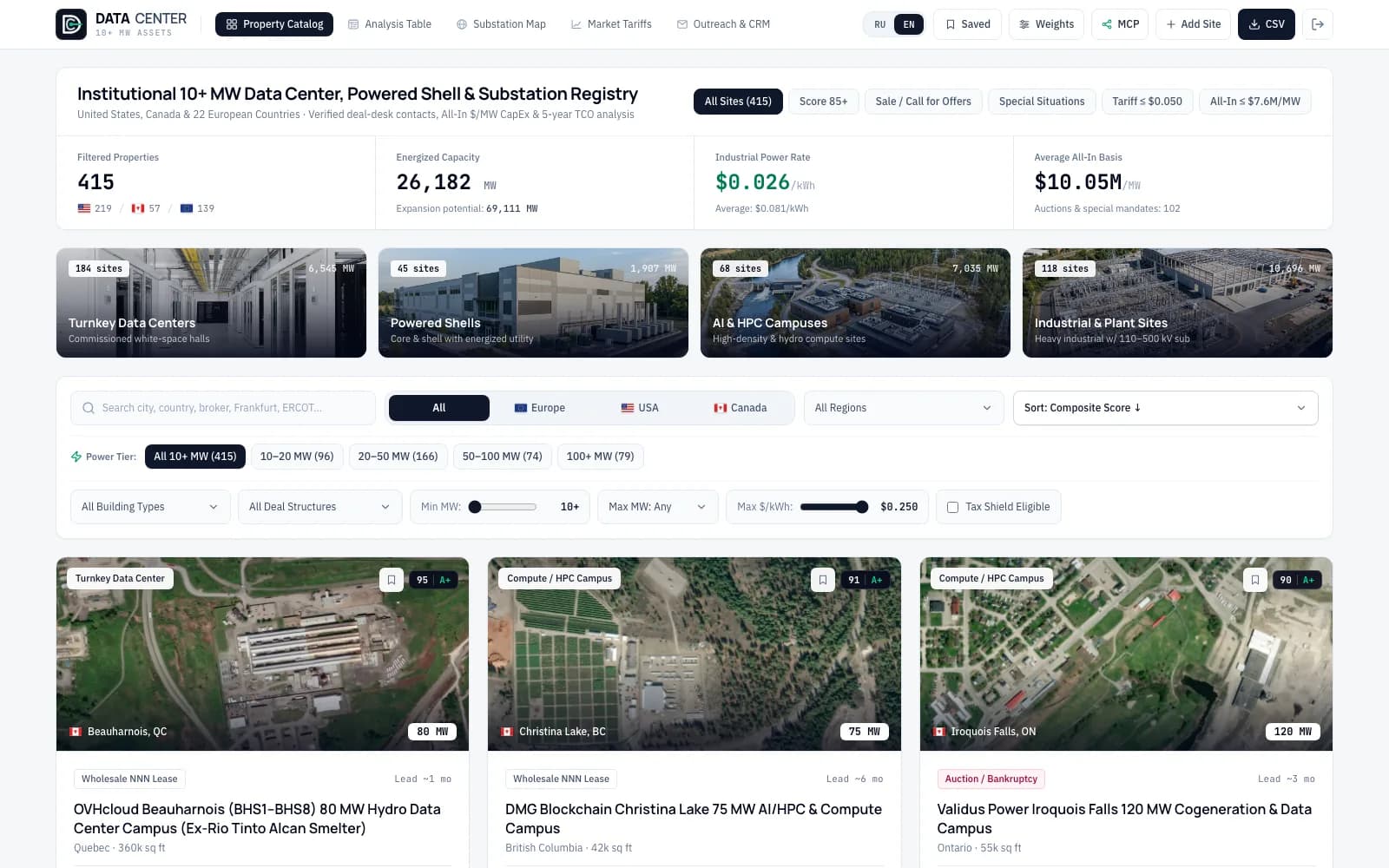
Turnkey data centers, powered shells, AI and mining campuses and industrial sites with substations across the USA, Canada and Europe in one private catalog, with a 0–100 score and a five-year cost of ownership for every site.
// Your project
Let's build this for you
Describe the task. An engineer replies within 24 hours with a plan and an estimate.